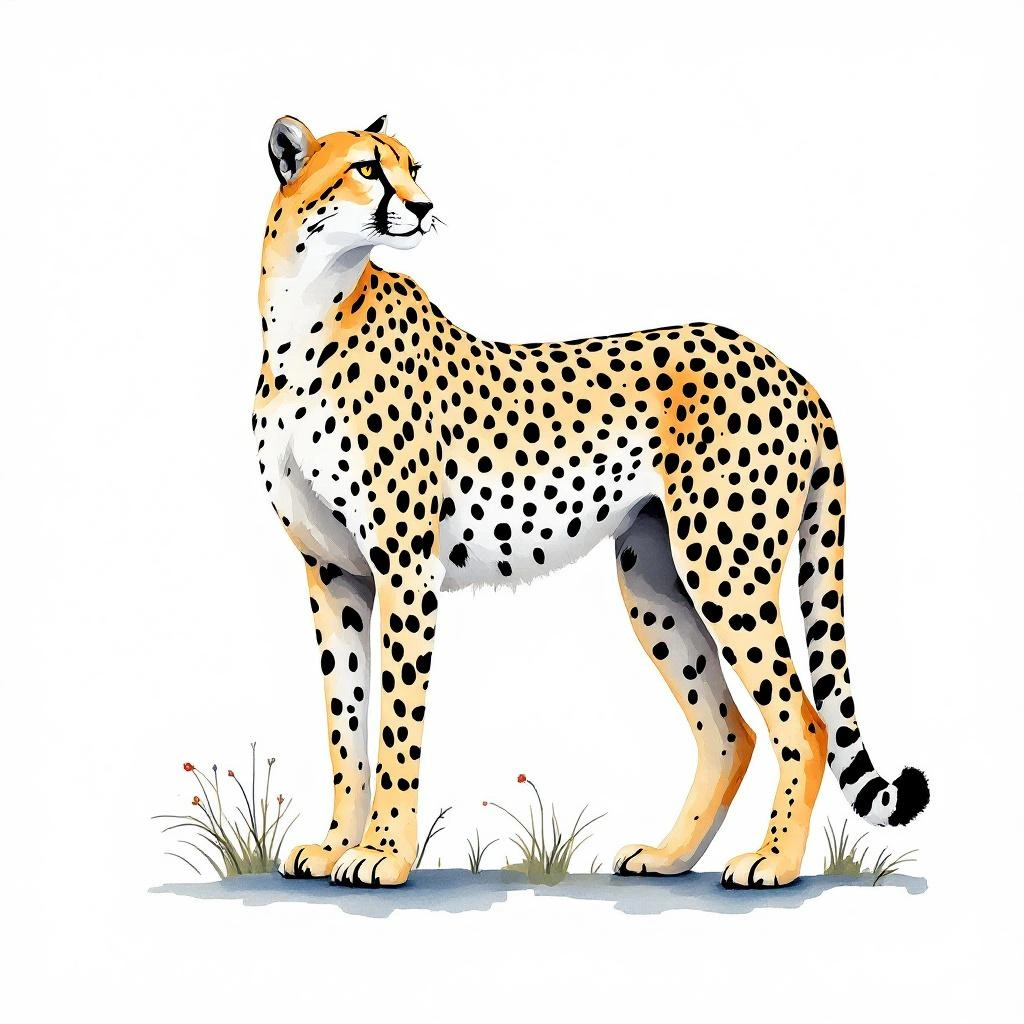
Watercolor illustration of Gepard (Acinonyx jubatus)

Gepard

Acinonyx jubatus

Vulnerable
Diet
Carnivore
Lifespan
12 years
Length
1.5 m
Weight
50.0 kg
Population
6.7K
Trend
↓ Decreasing

About

The fastest land animal on Earth, reaching speeds of 112 km/h over short distances across African and Iranian grasslands. Slender build with a deep chest, long legs, and distinctive black tear-stripe markings. Unlike other big cats, cheetahs vocalize with chirps and purrs. Vulnerable, with only ~7,000 remaining due to habitat fragmentation and competition with larger predators.

Fun Facts

  • Cheetahs can accelerate from 0 to 100 km/h in 3 seconds.
  • Cheetahs cannot roar; they chirp and purr.
  • Their claws are semi-retractable, like running spikes.

Habitat & Distribution

Found across multiple habitat types including tropical and subtropical moist broadleaf forests, tropical and subtropical grasslands and savannas, and flooded grasslands and savannas, among 9 distinct biome types spanning the Afrotropic and Palearctic realms. Populations are also found in montane and highland environments at higher elevations.

Distributed across Botswana, Iran, Kenya, Namibia, and Tanzania. Currently classified as Vulnerable on the IUCN Red List, this species faces significant conservation challenges across its range.

Diet & Behavior

🥩
Carnivore
Gepard is classified as carnivore, adapted to its ecological niche.

Diet

🥩 Carnivore
Animal matter 100%

Conservation Status

VU Vulnerable
Estimated Population
6.7K
Population Trend
Decreasing

Full Taxonomy

Names in Other Languages

Spanish Chita
French Guépard
German Gepard
Arabic Fahad Sayad (الفهد الصياد)
Hindi Cheeta

Explore More

Frequently Asked Questions

What is the scientific name of Gepard?
The scientific name of Gepard is Acinonyx jubatus. It belongs to the genus Acinonyx.
What is the conservation status of Gepard?
Gepard (Acinonyx jubatus) is classified as Vulnerable by the IUCN Red List. The population trend is decreasing.
Where does Gepard live?
Gepard is found in Distributed across Botswana, Iran, Kenya, Namibia, and Tanzania. Currently classified as Vulnerable on the IUCN Red List, this species faces significant conservation challenges across its range.. Countries include Botswana, Iran, Kenya, Namibia, Tanzania.
What family does Gepard belong to?
Gepard (Acinonyx jubatus) belongs to the genus Acinonyx, which is part of the taxonomic family Felidae.
What does Gepard eat?
Gepard is carnivore. Its diet is adapted to its natural habitat and ecological niche.
How long does Gepard live?
Gepard has an average lifespan of approximately 12 years in the wild.
How many Gepard are left in the wild?
The estimated wild population of Gepard (Acinonyx jubatus) is approximately 6,700 individuals.
Is Gepard endangered?
Yes, Gepard (Acinonyx jubatus) is classified as Vulnerable on the IUCN Red List, which means it faces a significant risk of extinction in the wild.

Native Range — 5 Countries

Genus Acinonyx — 1 Species

🐆
Gepard
Acinonyx jubatus
VU

Nature FYI Family

Explore more of the natural world across our sister sites.

Part of the Nature FYI family — FYIPedia
